Showing posts with label film review. Show all posts

Sunday, 16 February 2014

Film shorts Jan/Feb

Yeah, science!

The rest of the films seen at the cinema in the last month.

Lone survivor
Marine unit fails to elicit ounce of sympathy for self-inflicted injury in this cringeworthy propaganda piece. Laughable.

Sideways & Nebraska (double bill)
Alexander Payne's duo of languorous treks through rural U.S. make me feel like I need some fine wine, and people need to be nicer. Recommended.

Gravity
Trailer-raised fears of 90 minutes of Bullock gasping unrealised. Charming and visually superlative. If Kowalski had paid attention in physics class they'd both still be alive. Unmissable.

Thursday, 16 January 2014

Film Review - 12 Years a Slave


Curzon Mayfair, 14/1/2014
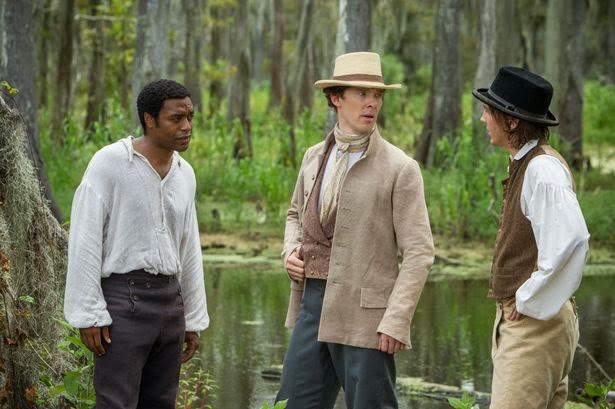
Steve McQueen returns to the big screen with this charged affair based on the memoirs of Solomon Northup, a black man born free in the northern states, who is abducted to the south and illegally sold into slavery. Chiwetel Ejiofor plays Northup, and the film follows him through the 12 years of his ordeal until he is released.

I am not going to make many friends by saying this, but though this is an important film due to its subject matter, I don't think it is remarkable as a film. Aside from the first ten minutes and the very last scene, which set the context for Northup's story, the rest of the film is a pretty generic depiction of slavery, tells us nothing new, and is largely irrelevant to the story. Northup's reluctance to reveal his legal status as a free man, for his own survival, and thus his true self, means that he has little genuine interaction with the other characters. The story is thus reduced to a series of episodes that do not develop either his character or the storyline, until the moment when the sympathetic Bass (Brad Pitt) comes along and agrees to help him. There is no sense at all of the twelve years passing, or of Northup developing any new insight or thoughts on his predicament or the wider question of slavery. If not for the clue in the title, this could have just as easily been six months a slave, for all that we see. The substance of the film is reduced to its depiction of the horrors and brutality of slavery, something I feel was portrayed at least as well in Django Unchained, to quote a recent if less serious example, and is just saying 'isn't it awful?'. In fairness, McQueen does innovate by acknowledging a degree of complexity in the culpability of some of those 'caught up' in slave ownership, such as Benedict Cumberbatch's sympathetic landowner Ford.

Ignoring the issue of substance, this is a beautifully shot film, as you would expect from McQueen. There is less use of the signature sense of detachment from use of medium range stationary camera angles than might be expected from previous films, with most of the action taking place outdoors. The south has rarely looked as sumptuous. The standout scene shows a prolonged near-hanging of Northup, as life goes on around him, and children playing nearby indifferent to his suffering. Ejiofor is outstanding, and indeed has to be to carry the film, as his aforementioned reticence about his situation limits his interactions and dialogue with the other characters. McQueen's long takes are very demanding of his ability to convey Northup's state of mind through subtle changes in his facial expression, and he rises to the occasion. Michael Fassbender as the sadistic Epps provides a counterexample at the brasher end of the scale, but is no less accomplished. Lupita Nyong'o also shines as Northup's fellow slave Patsie.

In the end this is an important work as one of few serious mainstream films that tackle slavery in America, and it will and should be widely seen. It is to its credit that it doesn't offer easy judgements. For instance Northup's outrage isn't obviously about the injustice of slavery, but about him being legally a free man who is abducted into slavery. The real Northup apparently went on to campaign for civil rights, but this is not covered in the film. Ultimately it is a nicely made depiction of episodes of barbaric cruelty and injustice bookended by 15 minutes of story, and says nothing on the subject that hasn't been said elsewhere. Not McQueen's best. 3.5/5

Wednesday, 15 January 2014

Top films of 2013

Beautiful things don't ask for attention (Sean O'Connell, The Secret Life of Walter Mitty. Still from The Great Beauty).


Here we are then, time to review the year in cinema. Somewhat embarrassingly, none of my top films have been reviewed in the blog. As a new reviewer with no background in the arts I find the better works much more difficult to review, and I find I am still reflecting on them when I would otherwise be writing. To rise above such challenges is a raison d'etre of this blog, and thus the blog's new year resolution is to do better and review more of what I see, especially the better films. These were my top films of 2013.


1. The Great Beauty. Sorrentino expresses a great love for present day Rome and la dolce vita (the lifestyle not the film, even though there are obvious parallels), while gleefully pointing out the emptiness and lack of purpose as Jep Gambardella searches for meaning towards the end of his writing career. From the opening party scene the audience is seduced into a life of parties and an appreciation of the finest and most beautiful that Rome has to offer. Gambardella's existential angst is conveyed in conversations with his pretentious circle, and his relationship with his neighbour, who overlooks his rooftop terrace next to the Colosseum. Every shot in this film is a beautifully composed piece of visual art in its own right, and Toni Servillo is pitch perfect as Gambardella. This is art cinema at its most flamboyant and seductive.

2. Blue is the Warmest Colour. By contrast Blue is the Warmest Colour is unflinchingly intimate, a close examination of a love affair between two young women. The much written about sex scenes are explicit and drawn out, but do function to immerse the audience in the intensity of the affair and pace of the film. Director Abdellatif Kechiche and the two leads Léa Seydoux and Adèle Exarchopoulos have created a remarkable piece that while it tips its hat to homophobia, class differences, and snobbery in the arts, is all about the passion of the love affair.

3. The Act of Killing. Joshua Oppenheimer's documentary focuses on the mass killings perpetrated against alleged communist sympathisers in Indonesia in the 1960s and 1970s. Oppenheimer follows Anwar Congo, a self-styled gangster and movie buff who led a gang of paramilitaries. These killers are at large and unrepentant, and are now represented by the Pancasila Youth organisation, which somehow still enjoys mainstream and government support, while its members extort with impunity. Congo and his associates as well as describing their actions, are invited to reconstruct some of the atrocities they carried out, sometimes with relatives of the actual victims. Some, like Congo, begin to realise what they have done, how it looks, and how it has affected people. Others seem to remain oblivious. Somehow Oppenheimer and his collaborators, many of whom remain anonymous for fear of reprisals, refrain from judging their subjects and allow them to come to their own realisations and condemn themselves by their own words and actions. The Act of Killing is a remarkable document of a brutal regime that is still influential, if not actually in power, contains many unforgettable scenes - some of the reconstructions are amazing, and a still charismatic lead subject in Anwar Congo.

4. Here Be Dragons. Mark Cousins' essay film was recorded in Albania in five days for a budget of £10,000 using a Panasonic HX-DC2. The trip was sponsored by the Albanian film institute in an effort to raise funds and awareness to preserve their decaying film archives. Cousins films as he travels through Albania, returning many times to a mysterious pyramid in Tirana. The narrative spins out from these starting points and considers questions of collective memory and identity, touching on landmarks in Albanian film history, but always coming back to the impact of the ostensibly communist former dictator Enver Hoxha in impoverishing the country. The centrepiece of the film is a letter addressed to Enver by Cousins that is accompanied by a long uninterrupted single take that addresses the impact of greed on Albania and on society in general. This is powerful and inspirational stuff, and shows that individuals can still make an impactful statement in these days of massive collaborative blockbusters.

5. The Secret Life of Walter Mitty. A paean to imagination, a longing for the days of analogue, slow living and prioritising the quality of work above profit. What's not to like in this feelgood light comedy? Ben Stiller directs and stars as Walter, a daydreaming photo stockist at Life magazine who gets drawn into a global adventure in pursuit of the negative for the cover of the last ever issue of the magazine. Kirsten Wiig plays Cheryl, the romantic interest, and Sean Penn shines in the few minutes he has as the photographer Sean O'Connell. We switch frequently from reality to Walter's imagination in the first half of the film, and in some cases we are left guessing as to which it is we are watching. However, when Walter decides to track down O'Connell he has to make several decision (red car or blue car? a Matrix reference!) that lead to him having real adventures. The film is funny, uplifting and life-affirming and the cinematography, particularly the location shots in Iceland, is beautiful. It also has two of the most memorable scenes I can remember from this year, Cheryl and Walter's Space Oddity helicopter scene and the skateboarding scene.

Honorable mentions for this year go to Only God Forgives - stylish, comic book violence, Ryan Gosling and one of the great screen villains, Carancho - pitch black drama from Argentina, and Borgman - a surreal Danish-Dutch psychological thriller.

Happy 2014!


Friday, 8 November 2013

Film Review: The Counselor

"Drink up man, it's delicious. Surely you're not doubting my taste?"
Preview at Curzon Mayfair - 7/11/2013

Cormack McCarthy, Pulitzer Prize winning author, follows success with adaptations of his novels The Road and No Country For Old Men by scripting The Counselor. Ridley Scott directs a heavyweight cast of Hollywood's finest. Unfortunately The Counselor ends up as less than the sum of its parts.

The unnamed counselor[sic] (Michael Fassbender) is seduced by the promise of riches and a glamorous lifestyle into getting involved in a drug smuggling ring, together with his dealer buddy Reiner (Javier Bardem). The other parties in the deal are the largely unseen Mexican cartels and Westway (Brad Pitt). The details of the deal and the roles of these players are unimportant, to the extent of not being explained beyond the most indistinct sketch. Women loom large in the background, with Penelope Cruz as Laura, the Counselor's fiancée and Cameron Diaz as Malkina, Reiner's girlfriend. Needless to say, the drug deal goes wrong and as the result of a series of apparent coincidences the Counselor gets into trouble with those nasty Mexican gangs. 

Unfortunately the film feels indecisive and in not focusing on either the counselor's undoing or the criminal underworld it fails to illuminate either satisfactorily. A film like Carlito's Way, for instance, is more satisfying in may respects from a similar starting point. The counselor's partners repeatedly advise him to not get involved, and there is little evidence of why he would want to given his seemingly very comfortable position. Dialogue is often restricted to a series of near-monologues that are oblique to the story. Many scenes are superfluous, for instance the diamond dealer, the bizarre car humping scene and the phone call with the counselor's oddly verbose philosophical friend. One tokenistic surreal scene has the counselor wandering through a nocturnal demonstration by grieving families of drug cartel victims. Fassbender's performance is vague, though this could reflect his character being outside his comfort zone throughout the film. Bardem is amusing but stilted and Cruz is criminally underused, reduced to being a muse for the Counselor even though her ethical position seems entirely opposed to his activities. Diaz's woozy performance suits the role - Malkina's character is inscrutable though her intelligence is hinted at in Reiner's lines but never demonstrated in any way until the unconvincing non sequitir ending. Brad Pitt is a comedy cowboy in a bad suit and performs much like he did in Burn After Reading, good in a comedy but inappropriate here.

Every shot of the film is beautifully composed, and shows the cars, bikes, apartments, villas, furniture and actors at their best. The director's background in advertising shows and everything looks beautifully seductive. The desert landscapes are stunning, like a less saturated Breaking Bad - but clearly geographically distinct - and evoke some of the atmosphere of McCarthy's novels. However given the writer's very visual prose style, it is surprising that the drama hasn't transposed effectively to the big screen. In the end we have a film that although enjoyable, doesn't begin to do justice to the considerable talents involved. 2.5/5

Friday, 14 June 2013

Film Review - Solaris (1972)


Kelvin stops to smell the roses
Renoir - 13/6/2013. Introduced by Will Self

This was a special 35 mm screening of Andrei Tarkovsky's Solaris, with an amusing and very personal introduction by Will Self, organised by A Nos Amours, a cinema enthusiast collective fronted by Joanna Hogg and Adam Roberts.
The film is an adaptation of the Stanislav Lem's 1961 SF novel of the same name. Set in the near future, it opens with a shot of reeds under water, a motif familiar from Tarkovsky's Stalker, and the first act is played out in a dacha in the countryside where the psychologist Kelvin is visited at his father's house by the cosmonaut Burton, who has returned from the planet Solaris. They discuss what Burton saw on Solaris and the future of the exploration programme. Kelvin himself is shortly to be on his way to Solaris. There is a strange but potent long scene where Burton and his son travel back from the dacha through heavy traffic - no attempt is made to conceal what is quite clearly a Japanese city. Though this film is supposed to be largely apolitical, I wonder if this scene is a vision of a future wider USSR empire?
Kelvin arrives at the station on Solaris to find one of the three occupants dead by his own hand, and the other two oddly evasive. It doesn't take long for Kelvin to discover why. Solaris, or something on it is alive and as the humans are probing it for information, the alien intelligence probes them by materialising as characters from the astronauts' memories or psyche. Kelvin's dead wife Hari appears to him, but only to the extent that he remembers her. Thus she cannot remember what she looks like, or any of her own past, except Kevin is directly involved. Initially resistant to this alien psychic neutrino being, Kelvin is haunted by his role in the original Hari's suicide and grows to love the proxy. What follows is a very Russian meditation on love, loss and the nature of reality and illusion. The cosmonauts however, though they are absorbed by their relationships with these manifestations, realise that having them around isn't healthy, and hatch a plan to bombard the surface of the planet with an x-ray transmission of Kelvin's brainwaves, which will provide the alien with the information it wants and make it leave them alone. The film ends with a chilling scene with Kelvin back at the dacha with his father.
The set design is basic, almost theatrical, but this isn't a pristine minimalist intergalactic vessel like those on Star Trek or 2001, it has a messier, almost steampunk or Jules Verne feel. The acting performances are quite remarkable, especially given the many long takes and the fact that many scenes were reportedly single takes due to the shortage of film. The film stock changes throughout, with different colour grading and abrupt shifts to black and white, probably by necessity unless there is some artistic intent I am missing completely. There is much to explore in this film - the imagery, literary (Tolstoy and Cervantes are quoted), philosophy of love and the human condition - and the slow pace encourages the viewer to slow down and take a look around. I am sure I will be watching it many times over on DVD. 5/5

Wednesday, 12 June 2013

Film Review - Beware of Mr Baker

High times for Mr Baker

Riverside Studios - 11/6/2013
Ginger Baker is best known for being the drummer and driving force behind the 1960s English rock power trio Cream, in which Eric Clapton did his best work, supported by Bassist Jack Bruce. Clapton and Bruce feature prominently in this biopic, which is compiled from stock footage of Baker and his various bands through the years, interviews with Baker and others, and animated sequences.
Though Baker comes across as a cantankerous, unconventional and irresponsible old man, the film is sympathetic enough to try to develop an understanding for his seemingly constant need to up sticks and start again from scratch, whether it be with his bands, marriages, or various countries around the world. This is a man who has three passions in life: music, his polo horses, and drugs. Everything else is by-the-by.
We see his life from his childhood, the early jazz drumming days, rock superstardom with Cream and Blind Faith, jazz fusion in the early 70s, living in Nigeria, Hollywood, Colorado, Italy, and finally back to South Africa.
The snappy editing and music clips, underpinned by Bakers rollicking drumming keep things moving along at a brisk pace, and given the subject, there is no way this could turn into a turgid hagiography, as music docs sometimes do. Remarkably, given the diverse nature of the source material, there is a strong visual style running through the film, helped by the editing and subtle manipulation of the older material. Baker is strident, forceful, selfish, and not always a cooperative subject, but all this is handled with understanding and humour, and I for one came out with renewed respect for the old man, despite what I have read about his behaviour elsewhere.
I saw this as the second part of a double bill with Not Dead Yet, the Jason Becker biopic, and it made for a nice companion piece, given the contrasting familial themes, and the more upbeat mood of the Baker film. Sitting directly behind me in the cinema was none other than Jimmy Page of Led Zeppelin, who laughed hard and often throughout the film, except when Ginger and Eric compared Ginger's drumming to John Bonham's. Now there's an exclusive you won't find in any other review. 5/5


Trailer: http://www.youtube.com/watch?v=W5seWMYG9kk

Film Review - Not Dead Yet


Jason Becker speaks through eye movements

Riverside Studios, 11/6/2013 (+ Q&A with director Jessie Vile)
Avid readers of 1980s guitar magazines will be aware of Jason Becker, the electric guitar prodigy from Mike Varney's seemingly endless stable of shredders, which included Yngwie Malmsteen, Vinnie Moore, Greg Howe, Shawn Lane, Marty Friedman, and Paul Gibert. Nostalgia aside, I have to admit not being a fan of Becker at the time, as (perhaps unfairly) I had him down at the Friedman/Yngwie end of the spectrum, whereas I was more of a Howe/Vai fanboy. Imagine a wasp humming Bach at 240 bpm, or Paganini, you get the picture. Becker had just got the gig as David Lee Roth's guitar player and was recording the A Little Ain't Enough album for Roth when he was diagnosed with amyotrophic lateral sclerosis (ALS, or Lou Gehrig's disease), a debilitating neurodegenerative condition. Not Dead Yet documents Becker's life and his continuing career as a composer.
Given that Becker was on the point of going stratospheric when the diagnosis and rapid deterioration came, most of the first two acts are pieced together from amateur footage, whether 8 mm film shot by his uncle, or VHS video from various sources. Aside from this we have interviews with various figures who knew him at the time, and many musicians who were aware of his work. He appears to led a charmed life until the diagnosis, and his personality and humour come across very clearly. Oddly, there are only two pictures in existence of Becker with David Lee Roth, who refused to appear in the film.
ALS hits Becker hard and he is given three years to live. He deteriorates very quickly, culminating in an strange moment in the film where we are seemingly led to believe he has died. The director even goes as far as to imply that his childhood friend thought he was dead and was shocked to receive a message from him. This seems to be an unnecessary cheap trick that the film doesn't need.
Following this mysterious near death experience, although almost completely paralyzed and able to communicate only through eye movements, Becker regains his spirit and humour and continues to compose music through some ingenious devices and with the help of his father and various musical folk.
Ultimately the film is about one man, his fierce spirit and will to live, and his family without whose incredible love and support he would be nowhere. Jason Becker would almost certainly have faded away and died had he not been the willful character that he is with the humour and personality that he has. Despite the absence of a narrator, the film maintains its momentum, and everything comes across through the clever editing of the mostly found footage, reinforced through interviews and snippets of Becker's own memoirs, read by his father. Apart from the cheap shot death scene, this film is a moving and inspiring testament to the human spirit, and you don't even have to like the music to enjoy it. 4/5

Trailer: http://www.youtube.com/watch?v=wGFDWTC8B8g

Tuesday, 11 June 2013

Film Review - Thérèse Desqueyroux

Thérèse: I wish I was in The Place Beyond The Pines

Curzon Richmond 8/6/2013
Thérèse Desqueyroux is the last film from Claude Miller who died last year at the age of 70. It’s based on a novel by François Mauriac set in the 1920s about a bright young woman (Thérèse, played by Audrey Tatou) who marries her slightly dull neighbour Bernard, played by Gilles Lelouche so that their estates can be united and they will have thousands of acres of pines.
It is established early on that though Thérèse is intelligent, she ‘thinks too much’ and ‘has too many ideas’, she has a dissonant desire to unite the families – ‘I'll marry you for your pines’, she says to her fiancée, straight-faced. Her childhood friend Anne (Anaïs Demoustier) becomes her sister in law, and though Thérèse, frustratedly, finds her ‘simple’, for a while she is a proxy through which Thérèse discovers the possibilities of a life lived with passion through Anne’s dalliance with another neighbour. Thérèse’s loyalties to the family are tested when she is assigned the task of speaking to the Jewish neighbour to put him off. Boorish Bernard and the marriage are insufferable and stifling and something has to give way. The stress of dealing with forest fires on the estate one summer is the trigger for Thérèse to hit out, and the illusive equilibrium is blown apart.
In a way it is a strange performance from Tatou. Gone is the cutesy doe-eyed gamine from Amelie and even the straight-laced Sophie from the execrable Da Vinci Code. She plays Thérèse with a determinedly sullen, blank expression throughout and an uninflected voice through which she aims her pointed asides at the dullards around her, which suits the role but makes it hard to empathise with her. Gilles Lelouche for once does not play himself and does a pretty solid job playing the macho, yet weak husband. I’m not convinced the director does a great job of convincing the viewer of Thérèse’s sharp mind (she is shown reading books and writing letters), but on the other hand I think that not spelling out her competing motivations really makes the film. These things are never simple and if Thérèse isn’t fully aware of the reasons behind her actions, why should we be?
The film also steers clear of making easy judgements – though Thérèse is trapped in this unsatisfactory situation, it is almost entirely of her own doing, and her actions as she hits out against the suffocating regime show she is unbalanced, we are led to sympathise more with Thérèse than Bernard. The cinematography does full justice to the beautiful châteaux and country estates, whose bright pastel tones contrast with the oppressive interiors and Thérèse’s sombre appearance. Aside from the jarring change when the adult Thérèse suddenly looks 15 years older than her still adolescent childhood friend, there is plenty to like about this film, and plenty of food for thought and scope for interpretation, but ultimately I’m not sure it hangs together as well as it could have. 3.5/5

Monday, 29 April 2013

Film Review - What Richard Did


Riverside Studios 26/4/2013
Set in Ireland, this is a tale of the eponymous late teen Richard, sports jock, popular, ambitious and clever, and seemingly with the world at his feet. Richard's world comes undone as a result of a drunken altercation that gets out of hand. In the aftermath of the tragedy, the film goes some towards exploring the implications of the attempted cover up, which weighs heavily on the parties involved, and the issue of his culpability is somewhat glossed over.
The first act takes an awfully long time to set the scene for 'what Richard does', or perhaps it just felt that way because the trailer gives so much away. Unfortunately, charming as he is, Richard does not elicit a great degree of sympathy precisely because his charm and obvious intelligence suggest that he should be above these actions and smart enough to know better. In the end it is his father Peter, played by Lars Mikkelsen, looking much older than in his role as Troels in The Killing, who steals the show and the sympathy of the audience. 3/5

Trailer: http://www.youtube.com/watch?v=xXTcSCp8R6E

Friday, 26 April 2013

Film review - Easy Money

"You should have seen me when I had finished adjusting my cufflinks" - Joel Kinnaman (middle), Matias Varela (L) and Dragomir Mrsic (R).
Preview at Odeon Covent Garden, 25/4/2013

Joel Kinnaman, previously seen in the US version of The Killing, shines in this hard edged and gritty Swedish crime thriller based on a novel by Jens Lapidus. Kinnaman plays JW, a poor business student who yearns to live like his wealthy classmates in a Stockholm business school and maintains his outwardly glamourous lifestyle on the cheap by living a secret double life as a taxi driver. In the meantime he is on the lookout for a rich girlfriend or business opportunity to provide him with the means to lead the life he craves. He appears to get his big break, but things soon unravel.
He is drawn into the Swedish drug trade by Jorge, played by Matias Varela, and Mrado, played by the bank robber turned actor Vladimir Mrsic. Soon enough the strain of leading a double life begins to tell, and JW begins to realise that he is no longer in control of his own fate. Loyalties are tested to breaking point.
Although it doesn’t entirely resist the melodrama and moralising that blights Nordic noir, the film excels in developing the characters of Jorge and Mrado so that we sympathise with both even as we appreciate their criminal intent. Kinnaman’s performance in particular is superb, his gradual transformation from insecure student to criminal mastermind and down is subtly and masterfully played. Mrado is convincing too, oscillating between sensitive father and menacing heavy. Director Daniel Espinosa never lets the tension slip and the shocking violence, thrills and drama add up to a very good film indeed. 5/5